
Agentic AI in one sentence
IBM’s definition is a good starting point: agentic AI is “an artificial intelligence system that can accomplish a specific goal with limited supervision.”
Each part of that sentence does work.
A specific goal. You give it an outcome, not a single question. “Reconcile last month’s invoices,” not “what’s an invoice?”
Limited supervision. It decides the steps itself instead of waiting for you to prompt each one.
Accomplish. It finishes the task by taking actions in real systems, not just by writing text about it.
Under the hood, most agentic AI is built on the same large language models behind ChatGPT, Claude or Gemini. The difference is what’s wrapped around the model: tools, memory, and a loop that lets it keep going until the job is done.
How agentic AI works: the loop
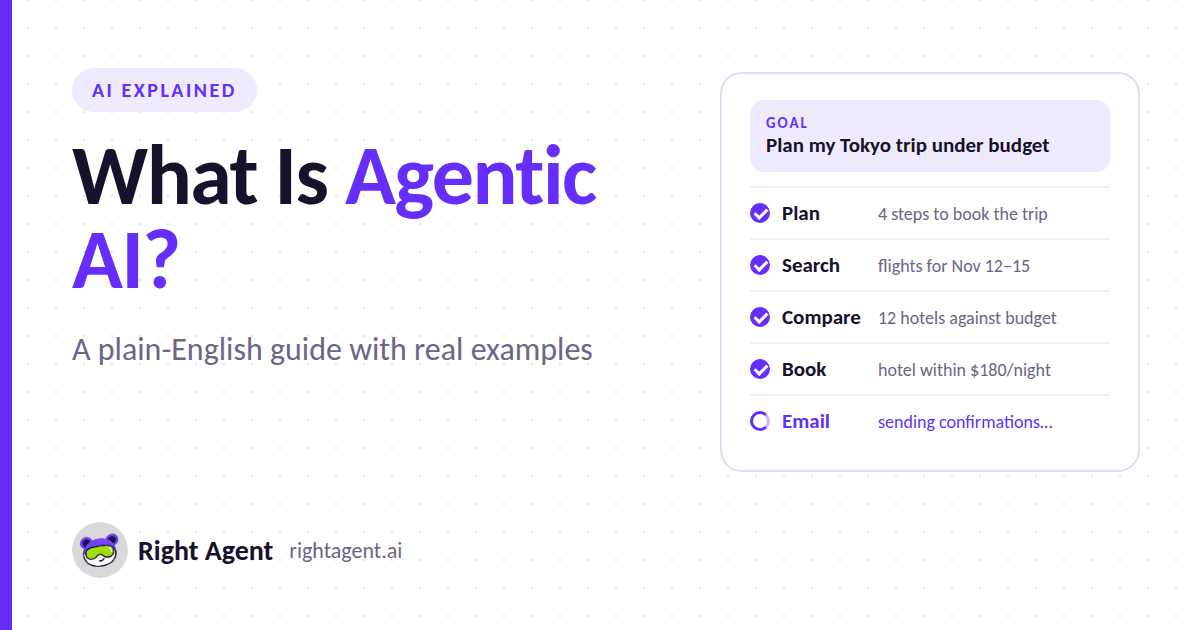
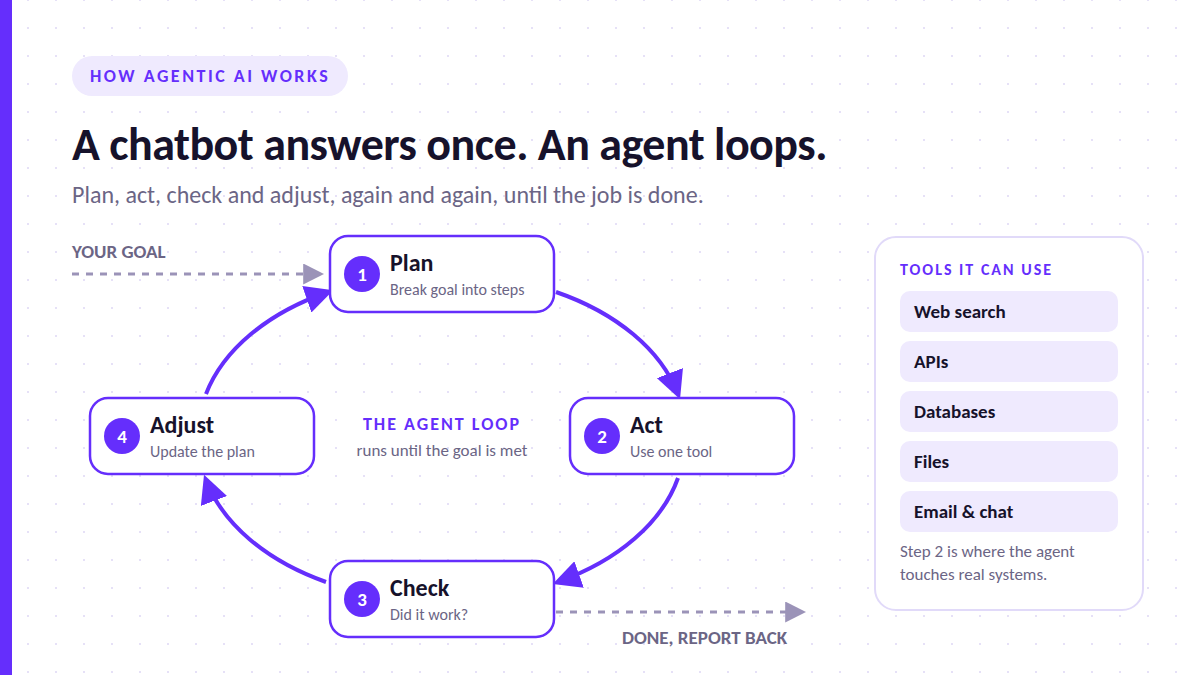
Almost every agentic system follows the same basic cycle.
Understand the goal. It reads your request and any context it has access to.
Plan. It breaks the goal into steps.
Act. It uses tools to do a step: searching the web, calling an API, querying a database, writing a file, sending a message.
Check. It looks at what happened. Did the step work? Is the goal closer?
Repeat or finish. It adjusts the plan and carries on, or stops and reports back.
That loop is the whole idea. A regular chatbot runs through it once and hands you text. An agentic system runs through it as many times as it needs to, changing course based on what it finds.
Agentic AI vs generative AI vs AI agents
These three terms get mixed up constantly. Here’s how they relate.
Generative AI | AI agent | Agentic AI | |
|---|---|---|---|
What it is | A model that creates text, images or code from a prompt | A single piece of software that uses AI to complete tasks | The broader approach of AI systems that act toward goals on their own |
How you use it | You ask, it answers, you ask again | You give it a task, it works through the steps | You give it an outcome, one or more agents plan and carry it out |
Autonomy | Low: you direct every step | Medium to high, within its task | High, often across several tools or systems |
Example | Asking a chatbot to draft an email | An agent that triages your support inbox | A system that handles invoices end to end: validating, routing approvals and scheduling payments |
Put simply, generative AI creates, AI agents do, and agentic AI is the umbrella term for AI built to pursue goals and take action. Thomson Reuters sums up the difference well: generative AI responds to input, while agentic AI “makes decisions and takes action to keep a process going.”
A Clear difference between AI agents, Chatbots and AI Assistant
Real examples of agentic AI in 2026
The fastest way to understand agentic AI is to see where it’s already working, and where it’s struggled.
Coding agents that write most of the code
Software development is where agentic AI has moved fastest. In early 2025, Y Combinator managing partner Jared Friedman said that for a quarter of its Winter 2025 batch, 95% or more of the code was AI-generated.
Anthropic, which makes Claude, published data in October 2026 on its own workforce. It found that time spent by AI agents passed total human work hours across the company in March 2026. Code commits per engineer were five times higher than six months earlier.
Tools like Claude Code and OpenAI’s Codex don’t just suggest a line of code. They read the codebase, plan changes across files, run tests, and fix what fails.
Customer service, with a lesson attached
Klarna’s AI assistant is one of the most quoted agentic AI examples. In its first month in 2024, it handled 2.3 million conversations, about two thirds of all customer service chats, with an average resolution time under two minutes. Klarna said it was doing the work of 700 people.
Then in May 2025, CEO Sebastian Siemiatkowski said cost had been “too predominant” a factor and that quality had suffered. Klarna started hiring human agents again so customers could always reach a person. The AI still handles most chats, but the company changed its mind about removing people entirely.
Agents that work for a full day
In October 2026, Notion launched agents that can run a single task for more than 24 hours. That’s a real shift. Early agents handled tasks lasting minutes. Long-running agents can take on projects like research, documentation or data cleanup that used to need a person checking in all day.
Agents with their own identities
Agentic AI is now treated as part of the workforce in a very literal way. In October 2026, Microsoft previewed Copilot Studio agents with their own Entra identities, mailboxes and Teams presence, and ServiceNow launched an “AI Passport” that records each agent’s identity, permissions and owner. When software gets its own login, it’s being treated as a worker, not just a tool.
The darker side
Agentic AI cuts both ways. In October 2026, researchers reported that criminals had misused an open-source penetration-testing tool to run autonomous agents against more than 1,200 websites. Security firm NorForge estimated a cost of roughly $50 per successful breach. The same abilities that let agents work alone also let them be pointed at the wrong goals.
Where agentic AI is heading
Analysts expect agentic AI to spread quickly. Gartner predicts that by 2028:
33% of enterprise software applications will include agentic AI, up from less than 1% in 2024.
At least 15% of day-to-day work decisions will be made autonomously through agentic AI, up from 0% in 2024.
In other words, agentic features will increasingly show up inside the software you already use, not just as separate products you choose to buy.
Where agentic AI still falls short
The same Gartner research comes with a warning: over 40% of agentic AI projects will be canceled by the end of 2027, “due to escalating costs, unclear business value or inadequate risk controls.”
A few patterns explain why.
“Agent washing” is everywhere. Gartner uses this term for vendors rebranding chatbots, RPA tools and assistants as “agentic” without real agentic capabilities. It estimates that only about 130 of the thousands of vendors claiming agentic AI actually offer it.
Agents still wait on people. Anthropic’s own data showed that about 80% of interactive agent session time is spent idle, waiting for a human to respond. The agent is often fast. The approval, the review or the missing information is what slows things down.
Cost-first rollouts backfire. Klarna’s reversal is the clearest example. Replacing people to cut costs, without protecting quality, tends to come back around.
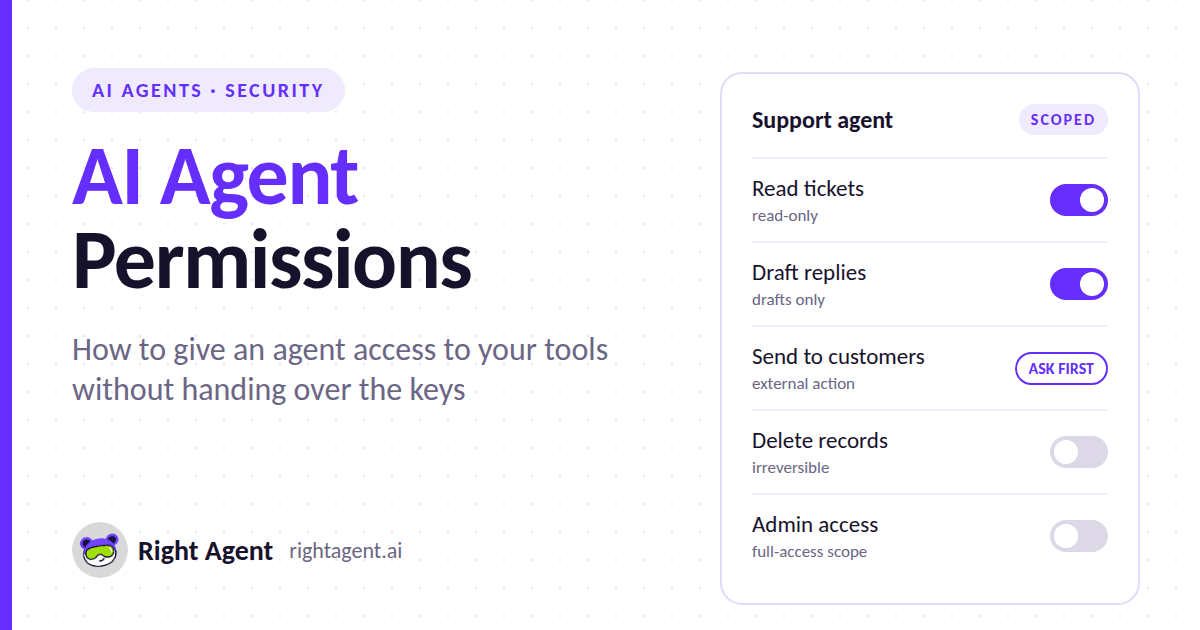
Autonomy needs guardrails. An agent that can act can also act wrongly. Permissions, approval steps and logs matter far more than they did with chatbots.
Are AI agents safe to use in 2026 ?
How to tell if a product is really agentic AI
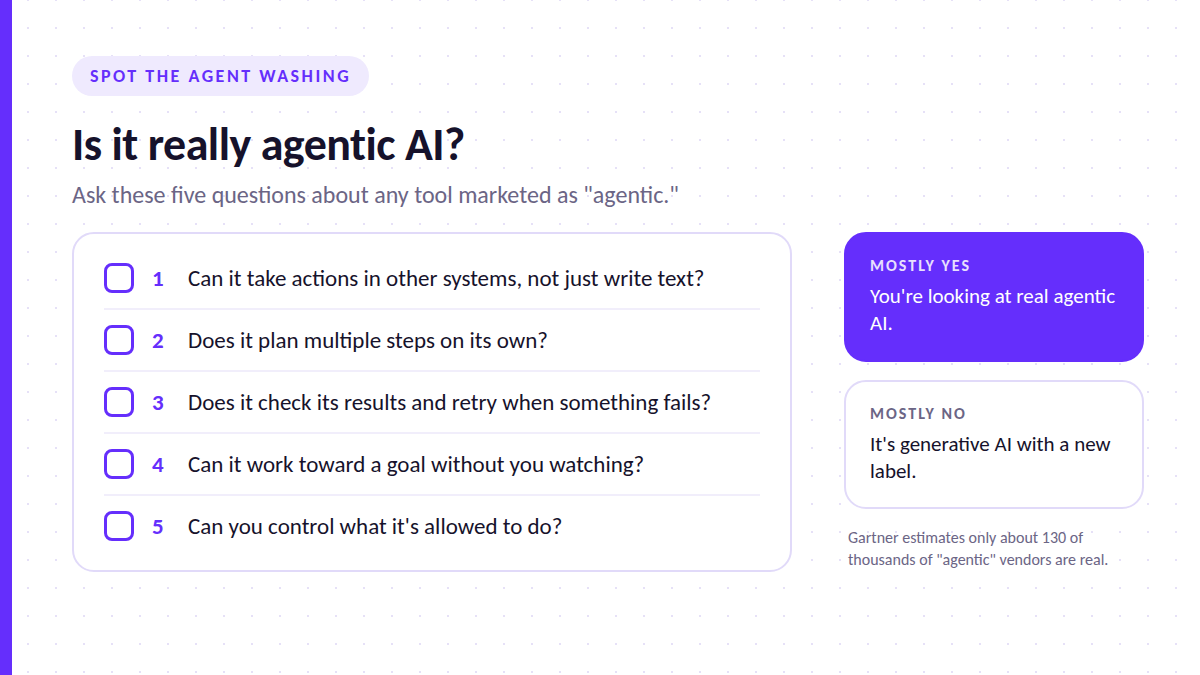
Given the amount of agent washing, it’s worth having a quick test. Ask these questions about any tool marketed as agentic:
Can it take actions in other systems, or does it only produce text for you to copy?
Does it plan multiple steps on its own, or do you have to prompt every step?
Does it check its own results and try again when something fails?
Can it work toward a goal without you watching, even for a few minutes?
Can you control what it’s allowed to do, with permissions and approvals?
If the answer to most of these is no, you’re looking at generative AI with a new label. That’s not necessarily bad, but it’s not agentic AI.
How to get started with agentic AI
If you’re curious about trying agentic AI at work, start small and specific.
Pick one repetitive, multistep task. Invoice processing, lead research, support triage or report building are common starting points.
Define what “done” looks like. Agents work best with a clear goal and a clear finish line.
Limit what it can access. Give it only the tools and data that task needs.
Keep a human on the irreversible steps. Let the agent draft and prepare. Have a person approve anything that sends, pays or deletes.
Measure the result honestly. Compare time, cost and error rate against how the task was done before.
The teams getting real value from agentic AI aren’t the ones with the most agents. They’re the ones that picked the right job for an agent and set it up carefully.
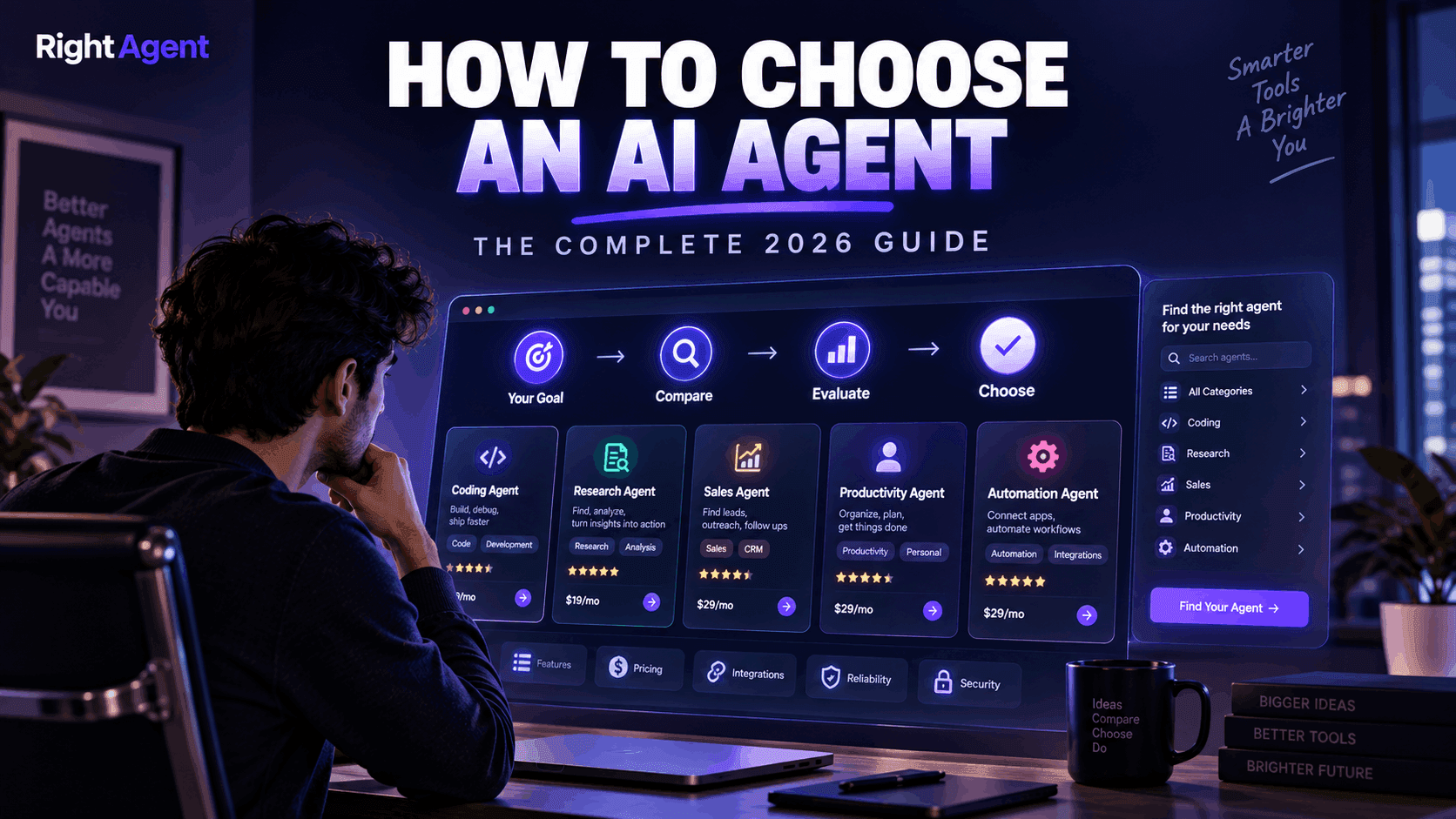
Here is complete guide for How to choose an AI agent