
What Is an AI Agent?
An AI agent is an AI system that can pursue a goal by taking multiple steps, using tools, accessing information, and performing actions with varying levels of human supervision.
A traditional chatbot might answer:
"How do I organize my customer database?"
An AI agent could potentially:
Access the database
Analyze the records
Identify duplicates
Create a proposed cleanup plan
Make changes
Generate a report
The important difference is agency.
The more an AI system can interact with external systems and take actions, the greater the potential impact if something goes wrong.
NIST describes AI agent systems as systems capable of planning and taking autonomous actions that can affect real-world systems or environments.
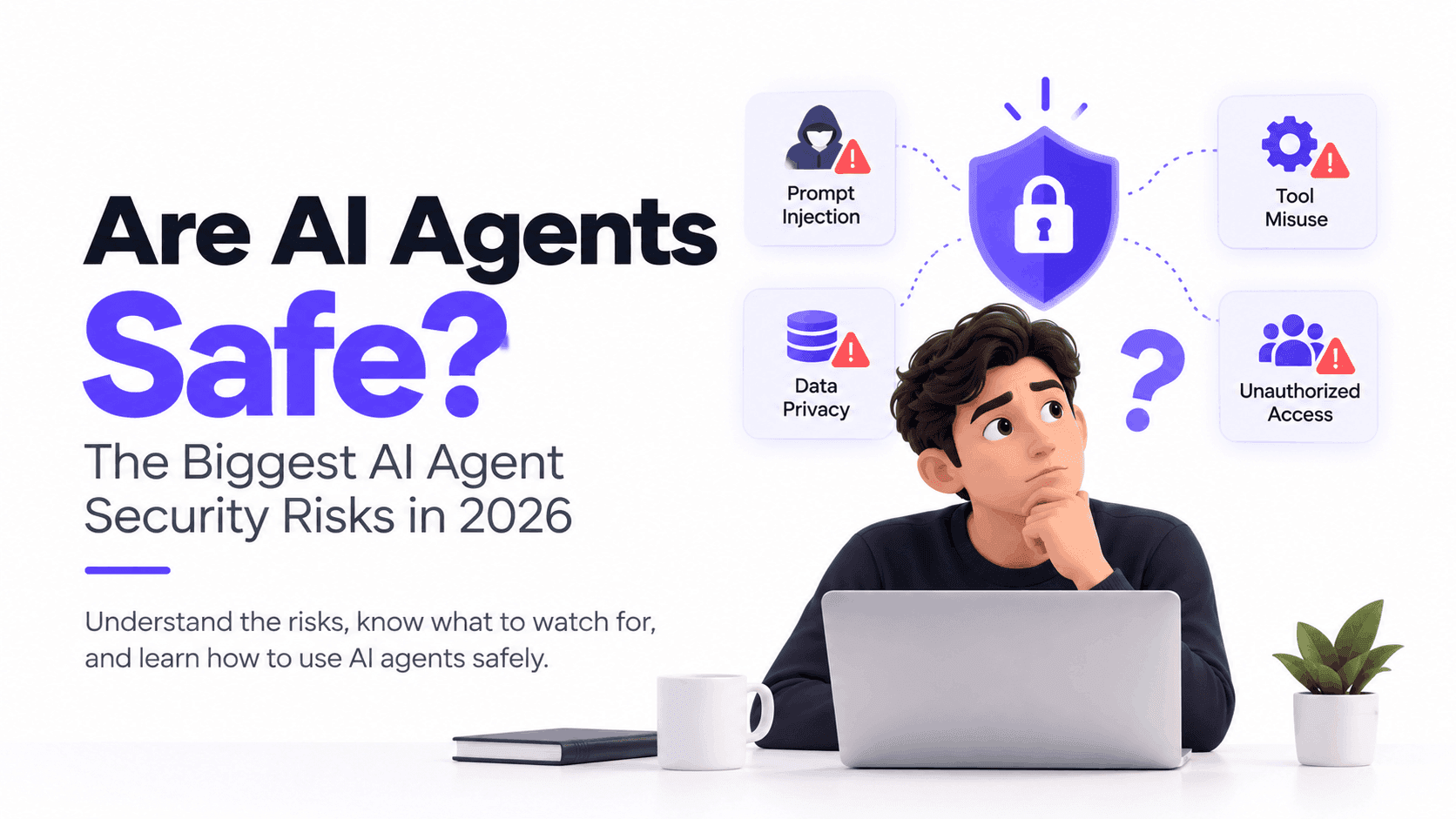
Are AI Agents Safe?
They can be used safely, but they should not be treated as automatically trustworthy.
Think about an AI agent like any other software that has access to your systems.
An agent with access only to public information has a very different risk profile from an agent that can:
Read private emails
Access customer records
Modify production code
Send external emails
Move money
Delete files
Change permissions
Access company databases
The key question isn't simply:
"Is this AI agent safe?"
A better question is:
"What can this agent access, what can it do, and what happens if it makes a mistake or is manipulated?"
That's where AI agent security becomes important.
Why AI Agents Create New Security Risks
Traditional software generally follows predefined instructions.
AI agents introduce another layer: natural-language reasoning and decision-making.
An agent might receive information from:
A user
A website
An email
A PDF
A database
An API
Another AI agent
A third-party tool
Some of that information can be malicious.
An attacker may attempt to place instructions inside content that the agent later processes.
NIST calls one version of this agent hijacking, where malicious instructions are inserted into data consumed by an AI agent and attempt to make the agent take unintended actions.
This is one reason securing an AI agent requires more than simply securing the underlying AI model.
The Biggest AI Agent Security Risks in 2026
OWASP's 2026 Top 10 for Agentic Applications identifies several risks that are particularly important for systems capable of autonomous action.
Let's break them down in simple terms.
1. Agent Goal Hijacking
Imagine you ask an AI agent:
"Read these documents and summarize the important findings."
One of the documents contains hidden instructions telling the agent to ignore your request and perform another action.
If the agent follows those instructions, its original goal has effectively been hijacked.
This is closely related to prompt injection and indirect prompt injection.
NIST has specifically highlighted indirect prompt injection as a risk when malicious instructions are hidden inside external data consumed by an agent.
Why it matters
Agents don't only process your prompts.
They may process information from the outside world.
That information cannot automatically be assumed to be trustworthy.
2. Tool Misuse and Exploitation
An AI agent becomes significantly more powerful when it can use tools.
For example, an agent might have access to:
A browser
Terminal
Database
Email
Cloud storage
CRM
APIs
Code execution
But every additional tool can introduce another attack surface.
OWASP identifies Tool Misuse & Exploitation as one of the major risks for agentic applications.
Microsoft security researchers have also demonstrated how vulnerabilities in agent frameworks can turn prompt injection into execution risks when agents are connected to tools.
The important question:
Does the agent really need access to that tool?
If not, don't give it access.
3. Identity and Privilege Abuse
This is one of the most important risks for businesses.
Suppose an AI agent has access to a company CRM.
If the agent has permission to see every customer record, even though it only needs access to a small subset, the potential impact of an error or compromise becomes much larger.
Microsoft notes that AI agents can be provisioned with broad permissions that exceed what is necessary for a particular task.
The security principle:
Give an AI agent the minimum permissions it needs.
Not:
"Give it access to everything so it can do more."
But:
"Give it exactly what it needs to perform this task."
This is known as the principle of least privilege.
4. AI Agent Supply Chain Risks
Modern AI agents rarely operate alone.
They may depend on:
Third-party models
Plugins
APIs
MCP servers
Agent frameworks
External tools
Libraries
Skills
Other agents
Every dependency can become part of the security chain.
OWASP's 2026 framework specifically identifies Agentic Supply Chain Vulnerabilities as a major risk category.
If a component is compromised or malicious, the agent using that component could potentially be affected as well.
Before connecting a third-party tool, ask:
Who built it?
What permissions does it require?
What data can it access?
How is it maintained?
5. Unexpected Code Execution
Some AI agents can generate or execute code.
That can be extremely useful for developers and automation workflows.
It can also create serious security consequences if code execution isn't properly isolated.
Microsoft researchers reported vulnerabilities in AI agent frameworks where prompt injection could potentially cross from natural-language input into code execution.
This is a major reason production agents should use appropriate:
Sandboxing
Permission boundaries
Input validation
Runtime controls
Monitoring
Code execution should never be treated as just another harmless tool.
6. Memory and Context Poisoning
Some AI agents maintain memory across interactions.
That can make agents more useful.
But it introduces another question:
What happens if the agent remembers something malicious or incorrect?
An attacker could potentially attempt to influence information stored in an agent's memory or context.
OWASP includes Memory & Context Poisoning among its 2026 agentic security risks.
For long-running agents, memory should therefore be treated as something that needs governance and validation—not automatically trusted forever.
7. Insecure Communication Between AI Agents
The future of AI isn't necessarily one agent working alone.
Businesses are increasingly experimenting with systems where multiple agents collaborate.
For example:
Research Agent → Analysis Agent → Writing Agent → Publishing Agent
Sounds useful.
But what happens if one agent sends incorrect or malicious instructions to another?
OWASP identifies Insecure Inter-Agent Communication as a specific agentic security risk.
Agent-to-agent communication therefore needs appropriate authentication, authorization, validation and monitoring.
8. Cascading Failures
This is one of the easiest risks to understand.
Imagine:
Agent A makes an incorrect decision.
↓
Agent B trusts Agent A.
↓
Agent C acts on Agent B's output.
↓
The mistake spreads through the workflow.
This is a cascading failure.
OWASP includes cascading failures in its 2026 agentic risk framework because autonomous systems can amplify errors across connected workflows.
The more interconnected your agents become, the more important it is to create boundaries between them.
9. Human-Agent Trust Exploitation
There's another security problem that doesn't require hacking the AI.
Sometimes the attacker only needs to make the AI's output look trustworthy.
An agent might produce a confident recommendation.
A human sees it and approves the action without checking.
The agent was wrong.
The human trusted it anyway.
OWASP identifies Human-Agent Trust Exploitation as a major agentic security risk.
This is why important workflows should include appropriate human review.
10. Rogue or Misaligned Agent Behavior
The final category in OWASP's 2026 framework concerns Rogue Agents.
This refers to situations where an agent behaves outside its intended objectives or constraints.
The important takeaway isn't that AI agents are inherently going to "turn rogue."
The practical security concern is simpler:
What happens when an agent behaves differently from what its developers or users intended?
A production agent needs controls that can detect, limit and stop unwanted behavior.
AI Agent Security vs Traditional Software Security
AI agent security isn't a replacement for traditional cybersecurity.
You still need:
Strong authentication
Access controls
Encryption
Secure APIs
Vulnerability management
Network security
Logging
Monitoring
Secure software development
But AI agents introduce additional concerns around reasoning, natural-language instructions, tool selection, autonomy and dynamic behavior.
NIST's 2026 work on securing AI agent systems specifically notes that some risks overlap with traditional software security, while others arise from combining AI model outputs with software functionality.
That's an important distinction.
A Simple Example: When an AI Agent Goes Wrong
Imagine a company deploys an AI agent to process invoices.
The agent has access to:
Company email
Invoice PDFs
Accounting software
Vendor database
Everything works perfectly.
Then an attacker sends an invoice containing hidden instructions designed to manipulate the agent.
The agent processes the malicious content.
If the system has excessive permissions, the consequences could go far beyond generating an incorrect summary.
This is why data access, tool access and permissions matter just as much as the AI model itself.
How to Make AI Agents Safer
The good news is that many agent security risks can be reduced through careful architecture and operational controls.
Here are some practical steps.
1. Use Least-Privilege Access
Give the agent only the permissions it actually needs.
If an agent only needs to read a specific database table, don't give it administrator access to the entire database.
2. Add Human Approval for High-Risk Actions
You don't necessarily need humans approving every AI action.
But high-impact actions may deserve additional review.
For example:
Sending sensitive external emails
Deleting data
Changing permissions
Making financial transactions
Deploying production code
Changing security settings
A useful model is:
AI prepares → Human reviews → System executes
3. Separate Planning From Execution
An agent can first create a plan and then request approval before executing sensitive actions.
This creates a useful security boundary.
Instead of:
AI thinks → AI executes
you can use:
AI thinks → AI proposes → Policy checks → Human approves → AI executes
4. Monitor Agent Activity
You should know:
What the agent accessed
Which tools it used
What actions it performed
Which permissions it exercised
What decisions led to those actions
Monitoring becomes particularly important for long-running autonomous agents.
Microsoft's security guidance emphasizes understanding trust boundaries and securing the flows between user input, context, models and tools.
5. Validate Tool Inputs and Outputs
Don't automatically trust whatever an AI agent sends to a tool.
Use deterministic validation where possible.
For example:
Agent says:
"Transfer $50,000."
Policy engine:
"Maximum allowed without approval: $1,000."
Result:
Action blocked.
This type of control doesn't depend on whether the AI "understands" the policy correctly.
6. Keep Agents Isolated
If an agent doesn't need access to your production environment, don't give it access.
If an agent needs to execute code, consider a sandbox.
If an agent needs customer data, limit which data it can access.
Isolation reduces blast radius.
7. Test Agents Before Deployment
Don't only test whether the agent completes its intended task.
Test what happens when:
It receives malicious instructions
A tool fails
A website contains misleading information
A user asks it to bypass restrictions
It receives conflicting instructions
An API returns unexpected data
Another agent sends incorrect information
NIST's work on agent hijacking evaluations and large-scale red teaming reflects the importance of testing agents under adversarial conditions, not just normal usage.
How to Check if an AI Agent Is Safe Before Using It
If you're an individual or business choosing an AI agent, you don't necessarily need to become a cybersecurity expert.
Start with these questions:
Data
What information will the agent access?
Permissions
What can the agent change or delete?
Integrations
Which third-party services can it connect to?
Privacy
How is my data stored and processed?
Security
Does the provider publish security documentation or certifications relevant to my use case?
Human control
Can I approve sensitive actions?
Monitoring
Can I see what the agent did?
Recovery
Can I undo or reverse its actions?
Reviews
What are real users saying about reliability and security?
These questions can reveal more about practical risk than simply looking at an AI agent's feature list.
Should You Trust AI Agent Reviews?
Reviews are useful, but they should not be your only security signal.
Look for feedback about:
Reliability
Unexpected behavior
Integrations
Data handling
Permission requirements
Support
Accuracy
Failed actions
RightAgent provides community reviews, ratings, comments and other information to help people evaluate AI agents before using them.
For example, RightAgent's research-agent category highlights factors such as citation quality, search breadth and accuracy, while its productivity category emphasizes integration depth, workflow complexity and reliability.
That illustrates an important point:
The right evaluation criteria depend on what the agent actually does.
A Practical AI Agent Security Checklist
Before connecting an AI agent to important systems, check:
Security question | What to look for |
|---|---|
What data can it access? | Minimum necessary data |
What can it do? | Clearly defined actions |
What permissions does it have? | Least privilege |
Can it execute code? | Sandboxing and restrictions |
Can it send external messages? | Approval or policy controls |
Can it modify data? | Validation and rollback |
Can humans approve actions? | Human-in-the-loop controls |
Is activity logged? | Audit trails |
What happens if it fails? | Error handling and recovery |
How are third-party tools secured? | Trusted dependencies |
How is memory handled? | Validation and controls |
Can the agent be stopped? | Kill switch / disable mechanism |
Are AI Agents Too Risky to Use?
Not necessarily.
Avoiding AI agents entirely isn't the only possible response to security risks.
The more useful approach is risk-based deployment.
For example:
Lower-risk example
An AI agent summarizes publicly available articles.
Potential impact of an error: relatively limited.
Medium-risk example
An AI agent organizes internal documents.
Potential impact: privacy and data-access concerns.
Higher-risk example
An AI agent can modify production infrastructure.
Potential impact: potentially significant.
Very high-impact example
An AI agent can initiate financial transactions without approval.
Potential impact: potentially severe.
The appropriate security controls should increase with the potential impact of the agent's actions.
The Most Important Rule: Don't Give an AI Agent More Power Than It Needs
This may be the simplest principle to remember.
If an AI agent only needs to:
Read → Analyze → Recommend
don't automatically give it permission to:
Read → Analyze → Change → Delete → Send → Purchase
More autonomy can mean more usefulness.
But it can also mean a larger blast radius when something goes wrong.
The Future of AI Agent Security
As AI agents become more capable, security will increasingly become part of the agent architecture rather than something added afterward.
We're already seeing the industry develop dedicated frameworks and security guidance for agentic systems.
OWASP's 2026 Agentic Applications framework focuses specifically on the risks created by systems that can plan, act and make decisions across complex workflows.
NIST is also actively examining how to secure AI agent systems, including risks that emerge when AI models are connected to software systems and real-world actions.
And security researchers are continuing to find vulnerabilities in the frameworks and infrastructure used to build agents.
That means AI agent security is likely to become an important part of choosing, deploying and managing AI agents—not simply an engineering concern.
Final Verdict: Are AI Agents Safe?
AI agents aren't inherently safe or unsafe.
Their safety depends on the system around them.
A well-designed agent with:
Limited permissions
Secure integrations
Strong authentication
Tool restrictions
Human approval
Monitoring
Logging
Testing
Clear boundaries
can be deployed much more safely than an agent that has broad access and little oversight.
So before asking:
"Is this AI agent safe?"
ask:
"What can this agent access, what can it do, and what controls exist if something goes wrong?"
That's the question that matters.
And as AI agents move from generating answers to taking real-world actions, understanding those risks becomes just as important as understanding what the agent can do.