
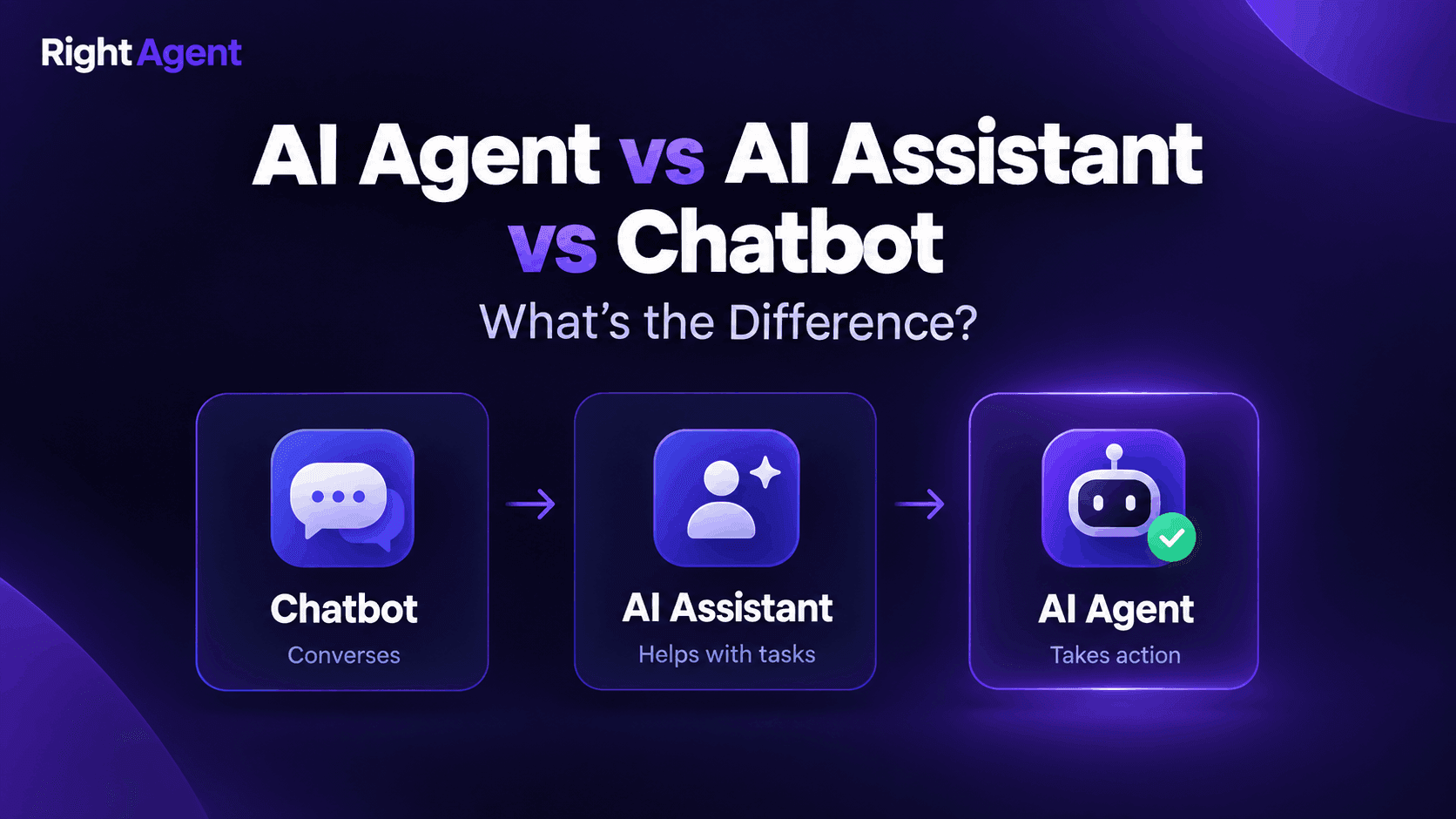
What is the actual difference between an AI agent, AI assistant, and chatbot?
This guide explains the difference in simple terms and helps you understand which type of AI is right for different tasks.
AI Chatbot vs AI Assistant vs AI Agent
The simplest way to understand the difference is to look at how much the AI can do on its own.
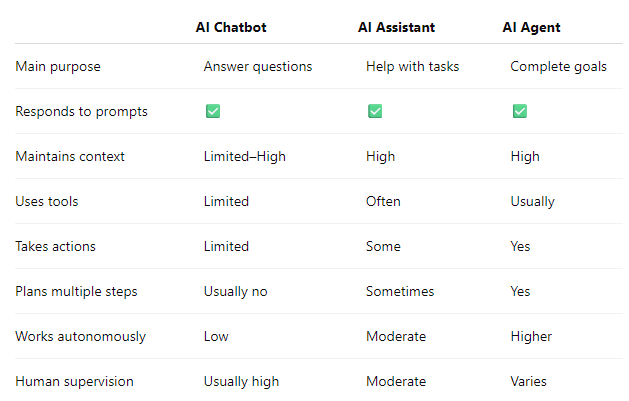
The boundaries aren't always strict. Modern AI products increasingly combine all three capabilities.
What is an AI chatbot?
An AI chatbot is primarily designed to communicate with you through conversation.
You ask a question, and the chatbot generates a response.
Example
You ask:
"Write a professional email asking for a meeting."
The chatbot generates the email.
You then decide what to do with it.
Common uses
Answering questions
Writing content
Summarizing information
Brainstorming
Translation
Basic customer support
Chatbots are excellent when your main requirement is information or generated content.
The limitation
A traditional chatbot generally waits for your next instruction.
It doesn't necessarily decide what needs to happen next or execute an entire workflow independently.
What is an AI assistant?
An AI assistant goes a step further.
Instead of only answering questions, an assistant can help you perform tasks using tools, connected applications, files or other information.
For example, an assistant might help you:
Draft an email
Summarize your documents
Analyze a spreadsheet
Schedule something
Search for information
Help write code
Organize information
The important difference is that an assistant is designed to help you accomplish a task, not simply maintain a conversation.
However, you generally remain involved in the process.
What is an AI agent?
An AI agent is designed to pursue a goal through multiple steps.
Instead of telling the AI exactly what to do at every stage, you can give it an objective and allow it to determine the steps required to reach that objective.
Example
Imagine you tell an AI:
"Research the top 10 competitors in this market and create a comparison report."
A chatbot might explain how to do the research.
An assistant might help you research and organize the information.
An AI agent could potentially:
Search for competitors
Collect relevant information
Compare the companies
Organize the findings
Create a report
Ask for approval when necessary
That's the core idea behind agentic AI:
Goal → Plan → Act → Evaluate → Continue
The biggest difference: autonomy
The easiest way to distinguish these technologies is autonomy.
Chatbot
You ask → AI answers
Assistant
You ask → AI helps → You guide
Agent
You give a goal → AI plans → AI acts → AI reports the result
This doesn't mean every AI agent operates completely independently.
In real-world applications, human approval can still be required for important actions.
A simple real-world example
Let's say you need to book a business trip.
AI chatbot
You ask:
"What should I consider when booking a business trip?"
It gives you advice.
AI assistant
You ask:
"Help me plan my business trip."
It may help you compare flights, hotels and schedules.
AI agent
You give it a goal:
"Plan my three-day business trip within my budget and prepare the itinerary."
The agent could potentially research options, compare them, organize the itinerary and perform parts of the workflow depending on the tools and permissions available.
AI agent vs AI assistant: Are they the same?
Not exactly.
The difference is mostly about how independently the system can execute a task.
An AI assistant generally works with you.
An AI agent is designed to work toward a goal, potentially taking multiple actions along the way.
But there is no universal technical definition that separates the two perfectly.
Many modern AI products combine assistant and agent capabilities.
So instead of asking:
"Does this product call itself an AI agent?"
Ask:
"What can it actually do without me telling it every next step?"
When should you use each one?
Use an AI chatbot when:
You need a quick answer
You want to generate text
You want to brainstorm
You need an explanation
You don't need the AI to take action
Use an AI assistant when:
You want help completing tasks
You work with documents or data
You want AI integrated into your existing workflow
You want to remain closely involved
Use an AI agent when:
The task requires multiple steps
You want the AI to use external tools
You want repetitive work automated
You want the AI to make decisions within defined boundaries
You need an outcome rather than just an answer
Examples of AI agents
AI agents are now appearing across many categories.
Coding
Agents can inspect codebases, modify files, run tests and work through software-development tasks.
Examples include GitHub Copilot, Devin and coding-focused agentic tools.
Research
Research agents can search for information, analyze sources and produce structured results.
Perplexity AI is one example of an AI product focused heavily on research workflows.
Automation
AI agents can connect with applications and perform business workflows.
Tools such as workflow automation platforms can combine AI with APIs and connected applications.
Multi-agent systems
Some systems use multiple specialized agents that collaborate on one larger task.
Frameworks such as CrewAI and LangGraph are designed for building these types of workflows.
Are AI agents better than chatbots?
Not necessarily.
They solve different problems.
If you want a quick answer, an AI chatbot may be all you need.
If you want help completing a task, an AI assistant may be more appropriate.
If you want a system to execute a multi-step workflow, an AI agent may make more sense.
More autonomy does not automatically mean better results.
The right choice depends on the task, risk level, integrations, reliability and amount of control you need.
The future: AI that can act
The biggest shift happening in AI is the move from:
"Tell me something."
to:
"Get something done."
Chatbots made conversational AI mainstream.
Assistants made AI more useful inside everyday workflows.
AI agents are pushing the next step: AI that can plan, use tools and take action toward a goal.
As these systems become more capable, the important question will not simply be which AI model is the most powerful.
It will be:
Which AI agent can reliably do the job I need?
How to choose the right AI agent
Before choosing an AI agent, check:
Capability: Can it actually perform your task?
Autonomy: How independently can it work?
Integrations: Can it access the tools you already use?
Reliability: How often does it need corrections?
Permissions: What can it access or change?
Human control: Can you review or approve important actions?
Pricing: Does the cost make sense for your workflow?
Don't choose an agent simply because it is popular.
Choose it because it fits the job you need done.
Find and compare AI agents with RightAgent
With new AI agents appearing constantly, finding the right one can be difficult.
RightAgent helps you discover, compare and vet AI agents before trusting them with real work.
Explore agents by category, compare capabilities, read community reviews and find tools based on your specific use case.
👉 Find your next AI agent on RightAgent.
Because the goal isn't simply to find an AI tool.
It's to find the right agent for the job.