
Teams are smaller, and that changes what your startup first hires need to be. When there are only four or five of you, every seat carries more weight. And when AI tools already cover a real chunk of the work, the question isn’t just “who do we need?” It’s “what’s left that only a person can do?”
This post works through that question practically: what changed, which roles to fill first, what to test for, and what it costs.
What actually changed
A few data points show how far things have moved.
In April 2025, Shopify CEO Tobi Lütke told his teams: “Before asking for more headcount and resources, teams must demonstrate why they cannot get what they want done using AI.” That was a public company setting a rule, and plenty of startups quietly adopted the same test.
A month earlier, YC managing partner Jared Friedman said that for a quarter of the Winter 2025 batch, 95% or more of their code was AI-generated.
Then there are the outliers people love to quote. Lovable reported around $400M in ARR with 146 full-time employees in early 2026, roughly $2.7M per person. For comparison, a commonly cited average for public SaaS companies is around $300,000 per employee.
Treat those outliers as signals, not targets. Most startups won’t look like Lovable. But the direction is clear: small teams can now cover ground that used to need three times the headcount, if the people on them know how to work with AI.
The new rule: hire for judgment, use AI for volume
The simplest way to think about early hiring now is to split the work in two.
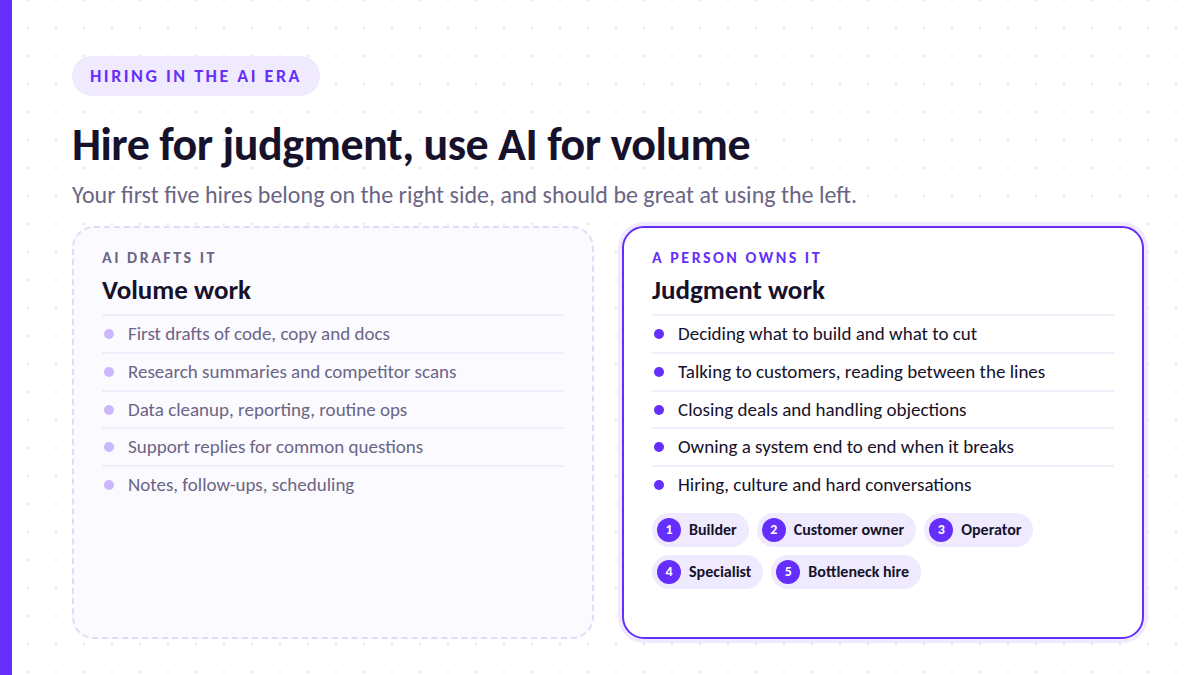
Usually fine to lean on AI early | Still needs a person |
|---|---|
First drafts of code, copy, docs and emails | Deciding what to build and what to cut |
Research summaries and competitor scans | Talking to customers and reading between the lines |
Data cleanup, reporting, routine ops | Closing deals and handling objections |
Support replies for common questions | Owning a system end to end when it breaks |
Meeting notes, follow-ups, scheduling | Hiring, culture and hard conversations |
The left column is volume work. AI does a decent first pass, and a person reviews it. The right column is judgment work. AI can assist, but someone has to own the call.
Your first five hires should mostly be right-column people who are very good at using the left-column tools.
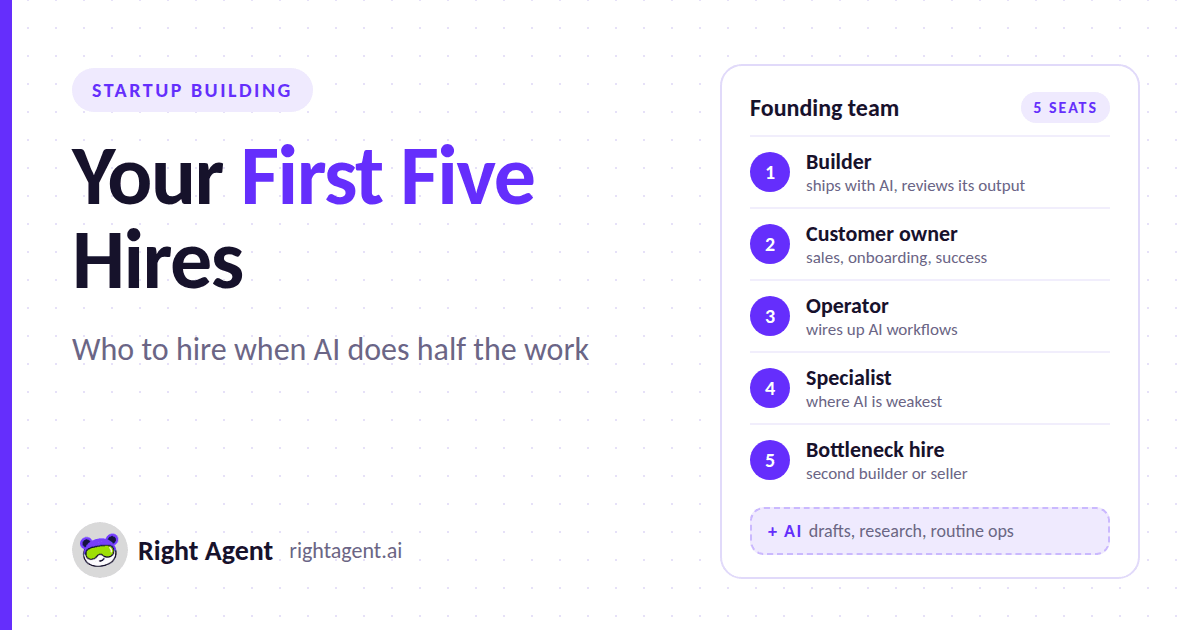
A practical order for your first five hires
There’s no universal sequence. It depends on what you’re building and what you, the founder, already cover. But this order works for a lot of AI-era software startups, and the reasoning behind each seat matters more than the order itself.
1. A builder who ships with AI. Your first technical hire should be someone who already writes code alongside AI tools and knows when to distrust the output. Someone who can produce a lot of code quickly isn’t the goal anymore. You want someone who can review AI-written code, catch the bad 10%, and keep the system understandable as it grows.
2. The person closest to the customer. If the founder isn’t already doing this full time, hire someone whose whole job is talking to users: sales, onboarding, success, all of it. AI can draft the follow-up email. It can’t sit on a call and notice that a customer’s real problem is different from the one they described.
3. An operator who wires the machine together. This is the generalist who sets up your AI workflows, connects tools, writes the internal docs and makes sure the agents doing support or reporting are actually doing it well. In a pre-AI startup this was often a “chief of staff” or ops hire. Now it’s closer to the person who manages your digital workforce.
4. A specialist where AI is weakest for your business. Every company has an area where generic AI output isn’t good enough. It might be design, security, a regulated domain, or deep expertise in your customers’ industry. Hire for that gap specifically, not for a generic role.
5. Double down on your bottleneck. By hire five, you’ll know where things pile up. If shipping is slow, add a second builder. If pipeline is thin, add a second seller. Let the evidence decide this one, not a plan you wrote a year ago.
[Internal link: link to Right Agent’s directory of AI agents for sales, support and ops, for founders deciding what to cover with agents before hiring.]
Run the “AI first” test before every hire
Shopify’s rule is worth borrowing, in a lighter form. Before opening a role:
Write down what this person would do in their first 90 days.
Try to cover that work with AI tools and existing people for two to four weeks.
Look at what didn’t get done, or got done badly. That gap is the real job description.
This does two things. It stops you hiring for work a tool could handle. And it gives you a much sharper description of the role you actually need, which makes the hire better.
It also helps with timing. Ashby’s 2026 hiring data shows companies under 25 employees take an average of 42 days to hire with a recruiter involved, and 62 days without one. That’s six weeks or more, so start the test early.
What to test for in interviews
If AI does half the work, the interview has to test the other half. A few approaches that work well:
Give a real task with AI tools allowed. Watch how they use them. Do they accept the first answer, or push back and check?
Ask them to review AI output. Hand them a flawed AI-generated draft, piece of code or analysis and ask what’s wrong with it. This tests judgment directly.
Ask about a decision they owned. Not a task they completed. A call they made, with incomplete information, that turned out right or wrong.
The people who do well here tend to be curious, a bit skeptical, and comfortable owning outcomes rather than tasks.
What your first five hires will cost in equity
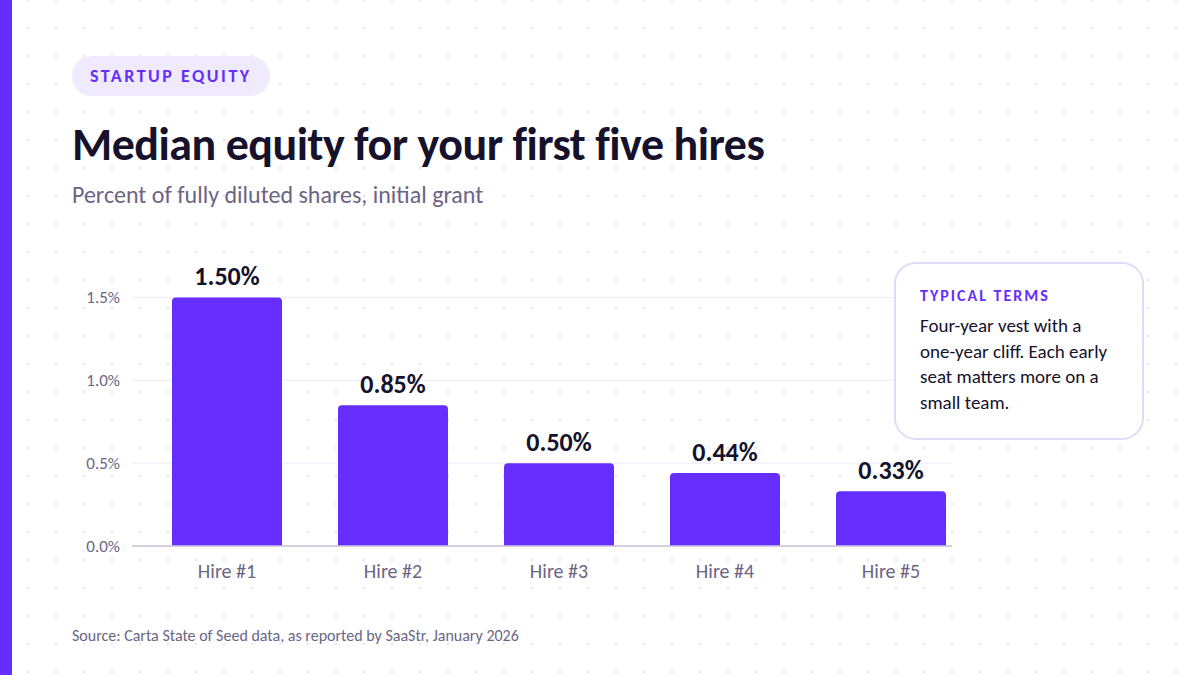
Smaller teams don’t mean smaller equity per person. If anything, each early hire matters more. Here are the median grants for the first five employees, from Carta’s State of Seed data as reported by SaaStr in January 2026:
Hire | Median equity (fully diluted) |
|---|---|
#1 | 1.50% |
#2 | 0.85% |
#3 | 0.50% |
#4 | 0.44% |
#5 | 0.33% |
These are typically four-year grants with a one-year cliff. Also note that AI/ML talent is getting more expensive. Carta found median initial equity grants for AI/ML engineers rose 31% between January 2024 and February 2026, compared with about 11% for individual contributors overall.
Two practical points follow. First, a smaller team can afford to be more generous with equity per person, and the best early candidates know that. Second, budget for AI tools and usage as a real line item. The work you’re not hiring for still costs money.
The takeaway
The founders getting this right aren’t trying to hire as few people as possible. They’re being deliberate about what each person owns. AI covers volume. People cover judgment, customers and the calls nobody else can make.
Before your next hire, run the test. Spend two weeks trying to do the work with AI and the team you have. Whatever’s left over is the job, and it’s usually more specific, and more interesting, than the role you were about to post.