
AI agents are changing how people work.
Instead of simply answering a prompt, modern AI agents can research information, write and modify code, browse the web, analyze documents, automate workflows, and complete multi-step tasks.
But with hundreds of AI agents available, finding the right AI agent for your specific task can be difficult.
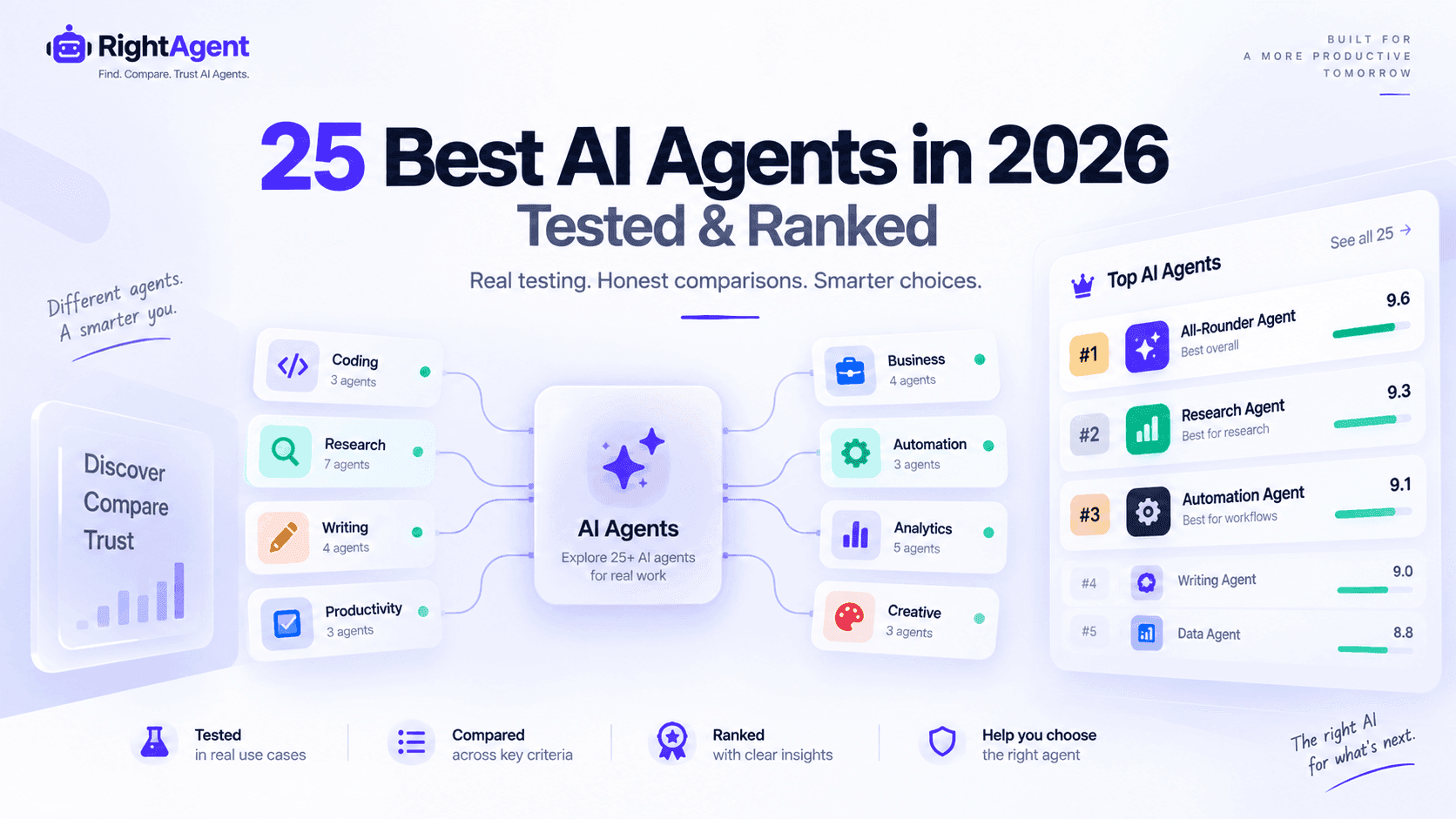
This guide compares 25 notable AI agents and agentic tools in 2026, focusing on what they are best at, who should use them, and where they fit into real-world workflows.
What this list is for
This isn't a list of AI tools based only on popularity.
We looked at factors such as:
What the agent can actually do
Level of autonomy
Reliability and usefulness
Integrations
Ease of use
Pricing and value
Best use cases
How much human supervision is required
There isn't one AI agent that is best for everyone. The right choice depends on what you want the agent to accomplish.
The 25 Best AI Agents in 2026
1. ChatGPT
Best for: General-purpose AI work, research, writing, analysis and automation.
ChatGPT is one of the most versatile AI platforms available, covering everything from everyday questions to research, coding, analysis and multi-step workflows.
Best choice for: Users who want one AI platform for a wide range of tasks.
2. Claude
Best for: Writing, reasoning, coding and document analysis.
Claude is particularly useful for complex knowledge work, long-form writing, coding and working with large amounts of information.
Best choice for: Developers, writers, researchers and professionals.
3. Gemini
Best for: Research, multimodal tasks and Google workflows.
Gemini is particularly useful for people already working within Google's ecosystem and for tasks involving multiple types of information.
Best choice for: Google Workspace users and researchers.
4. Microsoft Copilot
Best for: Workplace productivity.
Copilot brings AI capabilities into Microsoft's productivity ecosystem, making it useful for organizations already using Microsoft 365.
Best choice for: Businesses using Microsoft tools.
5. Cursor
Best for: AI-assisted software development.
Cursor is an AI-native coding environment that can understand codebases, make changes across files and help developers work through larger coding tasks.
Best choice for: Developers and engineering teams.
6. GitHub Copilot
Best for: AI-assisted coding and GitHub workflows.
GitHub Copilot helps developers write, understand and modify code, while its newer agent capabilities allow it to take on more autonomous development tasks.
👉 View GitHub Copilot on RightAgent
7. OpenAI Codex
Best for: Software engineering tasks.
Codex focuses on coding and software-engineering workflows, helping with repository-level tasks, code changes and development work.
Best choice for: Developers who want more than basic code generation.
8. Devin
Best for: Autonomous software engineering.
Devin is designed to take on multi-step development tasks, including understanding codebases, writing code, debugging and testing.
9. Perplexity AI
Best for: AI-powered research.
Perplexity is designed around web research, source discovery and answering questions using information gathered from multiple sources.
RightAgent currently lists Perplexity AI under its Research category.
👉 View Perplexity AI on RightAgent
10. Manus
Best for: Multi-step autonomous tasks.
Manus focuses on giving an AI a goal and allowing it to work through multiple steps to reach an outcome.
Best choice for: Users experimenting with more autonomous AI workflows.
11. Replit Agent
Best for: Building and prototyping applications.
Replit combines a browser-based development environment with AI-powered coding and application-building capabilities.
Best choice for: Developers, students, founders and rapid prototyping.
12. Lovable
Best for: Rapid web-app development.
Lovable allows users to describe an application in natural language and have AI generate and modify the application.
👉 View Lovable.dev on RightAgent
Best choice for: Founders, designers and developers building MVPs.
13. Windsurf
Best for: Agentic coding workflows.
Windsurf provides an AI-powered development environment designed around coding assistance and agentic software development.
Best choice for: Developers looking for an AI-native coding environment.
14. Cline
Best for: Developer-controlled coding agents.
Cline gives developers greater control over how an AI coding agent interacts with their development environment.
Best choice for: Technical users who want more control over agent actions.
15. Browser Use
Best for: Browser automation.
Browser-based agents can navigate websites, interact with pages and automate repetitive web tasks.
Best choice for: Workflows that depend heavily on browser interactions.
16. Zapier Agents
Best for: Business workflow automation.
Zapier's automation ecosystem makes it useful for connecting AI agents with business applications and recurring workflows.
Best choice for: Operations, marketing and business teams.
17. Salesforce Agentforce
Best for: Enterprise sales and customer service.
Agentforce brings AI agents into Salesforce's business ecosystem, where they can work with customer data and existing business processes.
Best choice for: Salesforce-based organizations.
18. CrewAI
Best for: Multi-agent workflows.
CrewAI allows multiple specialized agents to work together as part of a larger workflow. RightAgent currently lists it as a community-rated agent.
Best choice for: Developers building multi-agent systems.
19. AutoGen
Best for: Building multi-agent applications.
AutoGen is designed for developers and researchers building systems where multiple AI agents collaborate.
Best choice for: AI engineers and researchers.
20. LangGraph
Best for: Building controlled AI-agent workflows.
LangGraph provides developers with tools for creating customizable, stateful agent workflows with human-in-the-loop control.
👉 View LangGraph on RightAgent
Best choice for: Developers building production-oriented agent systems.
21. n8n
Best for: AI-powered workflow automation.
n8n connects applications, APIs and AI workflows, giving technical teams more control over automation.
Best choice for: Developers and technical operations teams.
22. Tabnine
Best for: Secure AI-assisted development.
Tabnine focuses on AI coding assistance with an emphasis on enterprise context, security and control.
Best choice for: Enterprise development teams.
23. Rewind
Best for: Personal knowledge and information retrieval.
Rewind focuses on helping users capture and retrieve information from their digital activities.
Best choice for: Knowledge workers who need to find information quickly.
24. Genspark
Best for: AI-powered productivity and task execution.
Genspark combines AI capabilities with broader task-oriented workflows.
Best choice for: Users exploring AI-powered productivity tools.
25. AutoGPT
Best for: Experimenting with autonomous AI agents.
AutoGPT helped popularize the concept of autonomous AI agents and remains relevant for people interested in agent experimentation and development.
Best choice for: Developers and AI enthusiasts.
Best AI Agents by Use Case
Use caseAgents to considerGeneral AIChatGPT, Claude, GeminiResearchPerplexity AI, ChatGPT, GeminiCodingCursor, Claude Code, Codex, GitHub CopilotAutonomous codingDevin, CodexApp developmentLovable, ReplitBusiness productivityMicrosoft Copilot, ChatGPTWorkflow automationZapier Agents, n8nMulti-agent systemsCrewAI, AutoGen, LangGraphEnterprise AISalesforce Agentforce, Microsoft CopilotSecure AI codingTabnine
What is the best AI agent in 2026?
There isn't one universal winner.
The best AI agent depends on the job.
For general-purpose work, ChatGPT, Claude and Gemini are strong options.
For coding, consider Cursor, Claude Code, Codex, GitHub Copilot and Devin.
For research, Perplexity is a strong starting point.
For building applications, Lovable and Replit are worth considering.
For multi-agent development, CrewAI, AutoGen and LangGraph are better suited to technical users.
The better question isn't:
What's the most powerful AI agent?
It's:
What's the right AI agent for the work I need done?
How to choose the right AI agent
Before choosing an agent, ask five simple questions:
1. What task do I want to automate?
Start with the problem, not the tool.
2. How much autonomy do I need?
Do you want suggestions, assistance or an agent that can execute multiple steps?
3. What tools does it need to access?
Check integrations with your existing software.
4. How reliable is it?
Look beyond marketing claims and check independent reviews and real user experiences.
5. What happens when it makes a mistake?
For important workflows, human approval and the ability to undo actions matter.
Why AI agent reviews matter
AI agents are different from traditional software.
A long feature list doesn't necessarily mean an agent performs well in real-world situations.
Before trusting an agent, look at:
Real user reviews
Task performance
Reliability
Pricing
Integrations
Permissions
Human oversight
Community feedback
That's why comparing agents before using them can save both time and money.
Find the right AI agent with RightAgent
The AI-agent ecosystem is growing quickly, and finding the right tool shouldn't require opening dozens of tabs.
RightAgent helps you discover, compare and vet AI agents before trusting them with real work.
Browse agents by category, compare tools, read community reviews and find agents based on the task you actually want to accomplish.
👉 Explore AI agents on RightAgent
The goal isn't to find the most hyped AI agent.
It's to find the right one for your work.