
A rename, then a $3.6 billion acquisition
Intercom's AI customer support agent has had an eventful 2026. In May, Intercom renamed its corporate entity to Fin, the same name as the AI agent itself, a signal of how central the product had become to the business. A month later, in June 2026, Salesforce signed a definitive agreement to acquire Fin for roughly $3.6 billion, with the deal expected to close in Salesforce's fiscal Q4 of 2027.
Pricing hasn't changed as a result of the acquisition, at least not yet. But a pending sale of this size is exactly the kind of thing worth factoring into a long-term buying decision, packaging and roadmaps have a way of shifting once deals like this actually close.
What Fin actually is
Fin is Intercom's customer-facing resolution layer, an autonomous agent that reads a customer's question, pulls from your knowledge base, and either answers directly, takes an action, or hands off to a human. It's a separate product from Intercom's Copilot, which is an agent-assist sidekick for human support reps, Fin is the one actually talking to customers, not helping an agent respond faster.
As of mid-2026, Intercom has started describing Fin as part of a broader "Customer Agent" architecture, capable of switching between specialized roles, service, sales, and others, based on conversation context rather than being a single-purpose bot.
The pricing model that made outcome-based support a real category
Fin popularized "pay per resolution" as a genuine alternative to seat-based support pricing. The listed rate is $0.99 per resolved conversation, with the pitch being straightforward: you only pay when Fin actually resolves something, not for every message it touches.
The model is fair in principle. It's less predictable in practice. The final bill depends on ticket volume, actual resolution rate, which channels you're running Fin on, and how "resolved" gets defined at billing time. Additional seat-based add-ons stack on top, Copilot runs $29 to $35 per agent monthly, and there are separate $99-per-month tiers for conversation analysis and proactive outbound messaging.
The number worth checking before you buy
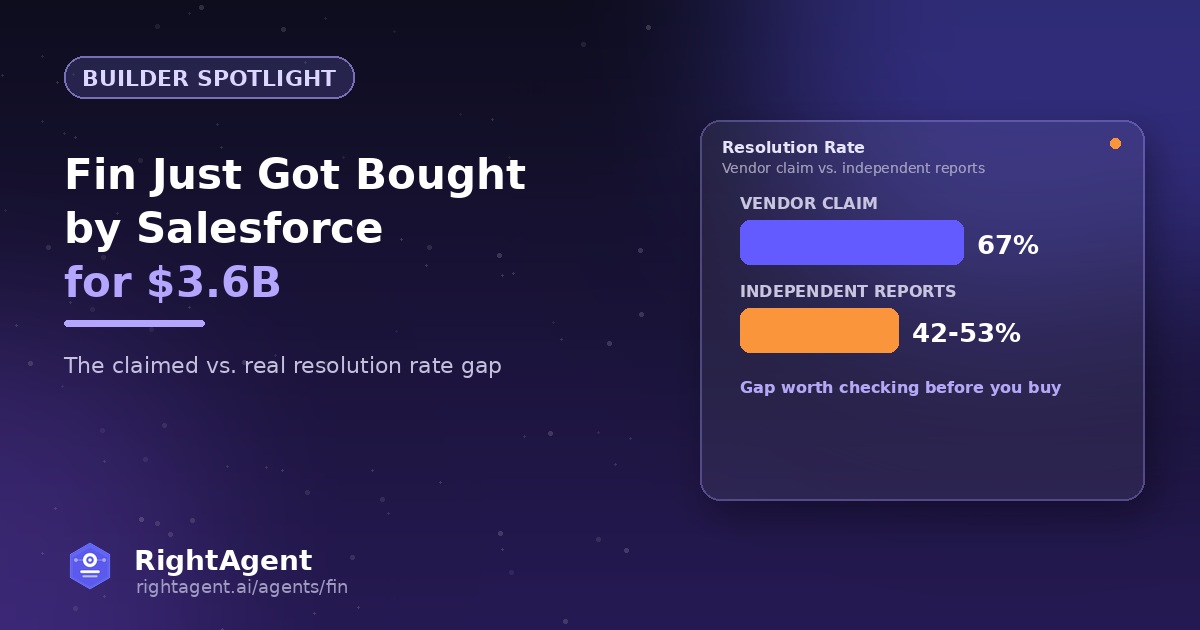
Here's the part that matters most if you're evaluating Fin specifically. Intercom's own reporting cites a resolution rate around 67%, based on a trailing 30-day figure across more than 40 million resolved conversations. That's the number in Intercom's marketing.
Independent sources evaluating real production deployments report something noticeably lower, generally in the 42% to 53% range. That's not a small gap, and it's not necessarily evidence of anything dishonest, resolution rate depends heavily on the quality of a company's own knowledge base, and a vendor's aggregate figure across its best customers will always look different from any single team's actual results. But it's exactly the kind of detail that's easy to miss if you're only reading the vendor's own case studies.
Intercom does back an enterprise-tier performance guarantee tied to a 65% resolution floor, which is a meaningful signal of confidence, but it also implicitly acknowledges that resolution rates can and do fall short of the headline number in real deployments.
Where it fits
If you're already on Intercom, Fin is the native path, and its pay-on-outcome pricing is worth taking seriously, especially at moderate conversation volume where the math tends to work in your favor. If you're running Zendesk or Freshdesk instead, several competitors now offer similar outcome-based pricing running on top of your existing stack, worth comparing directly rather than assuming Fin's model is the only option.
Either way, model your own numbers before committing. Pull a few months of your actual ticket volume, apply a realistic resolution rate rather than the vendor's best-case figure, and compare the resulting monthly cost against a seat-based alternative. The pricing is transparent. What it actually costs you depends entirely on your own traffic, not the number in the pitch deck.
See Fin listed, reviewed, and compared on RightAgent → rightagent.ai/agents/fin