
The number that matters more than any single product launch
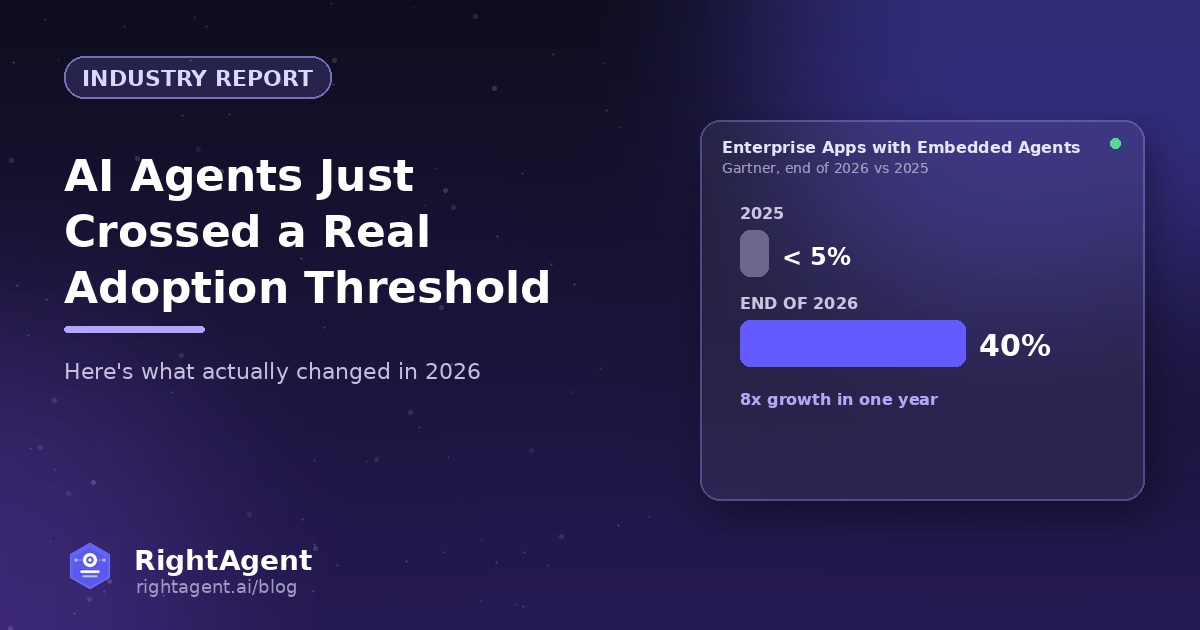
Gartner now projects that 40% of enterprise applications will have embedded AI agents by the end of 2026. A year ago, that figure was under 5%. That's not incremental growth, that's an industry crossing a real threshold in the space of twelve months, and it's worth understanding why it's happening now rather than six months ago or six months from now.
Demos were never the hard part
The AI agent space has spent the better part of two years producing impressive demos. What's changed in the last few months isn't the demos getting better, it's that companies have stopped being satisfied by them. The pattern showing up across recent coverage is consistent: teams that are actually seeing results picked one specific, messy, repetitive process, kept a human reviewing the output, and measured whether it genuinely saved time or reduced errors. Teams still stuck in pilot purgatory are the ones that bought into a general capability story without ever mapping it to one concrete workflow.
That's a meaningfully different bar than "can this agent hold an impressive conversation." It's closer to how you'd evaluate hiring an actual employee: not whether they interview well, but whether they measurably move a specific piece of work forward.
Governance is now the bottleneck, not capability
The uncomfortable part of this growth curve is that oversight hasn't kept pace with deployment. As agents gain the ability to trigger real actions across cloud services and business applications, the risk shifts from "the answer was wrong" to "the agent did something it shouldn't have had permission to do." Identity and access management, previously a fairly dry compliance topic, has become one of the more urgent open questions in agentic AI specifically because of this gap. A dedicated summit on exactly this problem, agentic AI risk and identity security, ran earlier this month, which tells you how quickly this went from theoretical to operational.
Practically, this means the agents worth trusting with real permissions are the ones with clear audit trails and explicit approval steps built in, not just the ones that produce the most polished output.
Pricing is becoming a differentiator, not an afterthought
The other real shift this month: model quality is no longer the only axis buyers are evaluating. Pricing structure and access tiers now matter almost as much. Usage-based billing, open-weight alternatives showing up inside mainstream products as a lower-cost option, and per-minute or per-task pricing models are all becoming standard parts of the comparison, not just the fine print. An agent that's technically excellent but structured in a way that makes cost unpredictable is a genuinely different buying decision than one with transparent, predictable tiers.
This is exactly the kind of detail that gets lost in a demo and only shows up once you're comparing real pricing side by side.
What this actually means if you're choosing an agent right now
Three things worth taking from this, concretely:
Ignore general capability claims, ask about one specific workflow. If a builder can't tell you which exact repetitive task their agent handles end to end, with a human checkpoint, that's a signal it's still closer to a demo than a production tool.
Ask what the agent can actually do, not just what it can say. Permissions and audit trails matter more this year than they did last year. An agent that only chats is a different risk profile than one that can execute real actions.
Compare pricing structure as carefully as capability. With usage-based and tiered pricing becoming the norm, the "best" agent for a given budget increasingly depends on how the pricing is built, not just how good the output is.
Where to actually compare
This is precisely the gap RightAgent exists to close. Every listing shows real, structured pricing tiers so you can compare cost side by side, not buried in a sales call. Community reviews and an independent quality score sit next to every agent, so you're not relying on a demo or a vendor's own pitch to judge whether something's actually production-ready. Browse by category, or describe what you need and let the matching tool point you to a specific fit rather than a general capability claim.
The agents worth adopting this year are the ones that can prove it on one real workflow. The ones worth avoiding are the ones still selling the demo.
See real, community-rated agents with transparent pricing on RightAgent → rightagent.ai/explore