
From research preview to production infrastructure
Codex didn't start as the polished, multi-surface agent it is today. OpenAI announced it as a research preview in May 2025, running on codex-1, a version of the o3 reasoning model tuned specifically for software engineering. It could write features, answer questions about a codebase, fix bugs, and propose changes for review, useful, but clearly early. ChatGPT Plus subscribers got access the following month.
What's happened since is a much bigger shift than a typical product update cycle.
The pace of updates tells its own story
By February 2026, OpenAI shipped a dedicated desktop Codex app, built specifically to manage multiple coding agents running in parallel over long stretches of time, not just handle single quick requests. Windows support followed in March. In the same window, the underlying model was updated twice: GPT-5.3-Codex arrived in early February, followed a week later by a lower-latency variant called GPT-5.3-Codex-Spark, notable as OpenAI's first production model deployed on Cerebras hardware, reportedly running around 15 times faster than earlier Codex versions for real-time interactive coding.
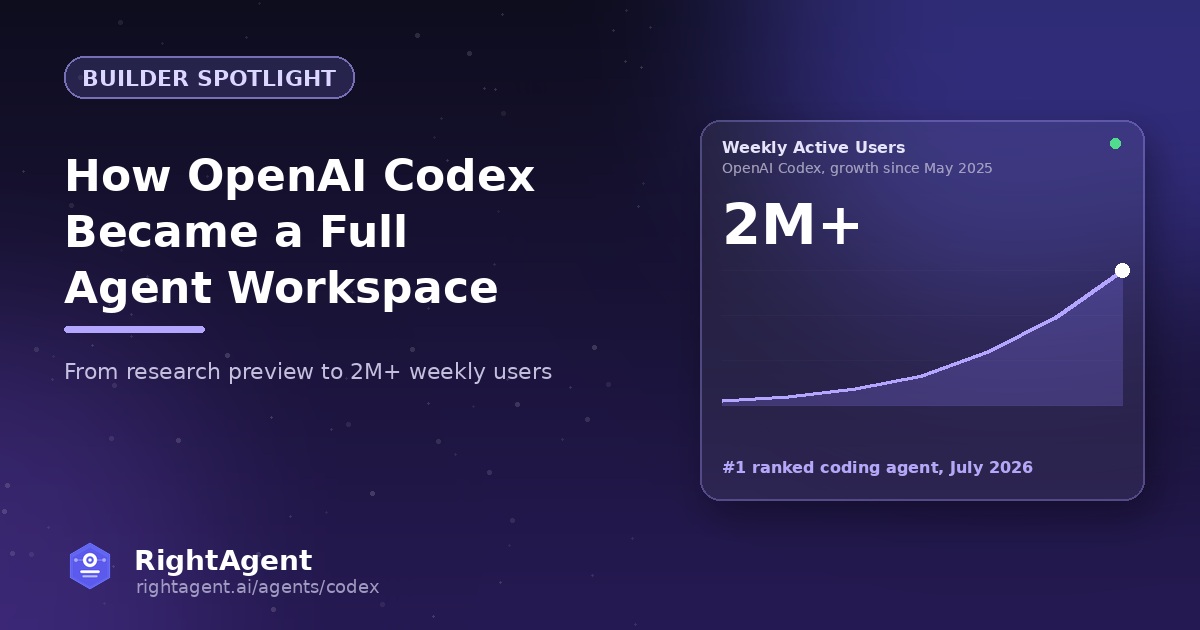
By March 2026, Codex had crossed 2 million weekly active users. OpenAI was already describing it as something broader than a coding assistant, an agent platform that could eventually handle work well beyond software development.
It's no longer just a coding tool
That repositioning shows up clearly in how Codex works today. It's no longer confined to a terminal or an IDE plugin. Codex now operates across the desktop app, cloud-based tasks, IDEs, GitHub, Slack, and Linear, with persisted goals that carry across sessions, browser-based verification for testing changes, and stronger permission profiles for controlling what an agent is actually allowed to do. OpenAI's own framing shifted from "coding assistant" to something closer to an operator console, a place where multiple agent workflows across code, browser checks, documentation, and automation actually converge.
As of July 2026, Codex is running on the GPT-5.6 model family, with the top-tier "Sol" model reaching general availability and claiming a meaningful token-efficiency gain on coding tasks specifically. In independent rankings published this month, Codex holds the top spot among AI coding agents overall.
What reviewers are actually saying
The most telling reviews aren't the launch-week ones, they're the ones written a year later by people who kept using it daily. One widely read 2026 review described starting most mornings by queuing several Codex tasks before doing anything else, then finding two or three completed pull requests waiting by the time other work was done. The same review was candid that its own earlier take on Codex had been skeptical, and that daily use over the following months had reversed that assessment entirely, largely because failure modes shifted from confusing crashes to clear, actionable "try a different approach" feedback.
That kind of grinding, week-over-week improvement is a different signal than a single flashy launch, and it's part of why Codex's usage numbers kept climbing rather than plateauing after the initial release excitement faded.
Where it fits
Codex is increasingly positioned as the broad, multi-surface option, useful if you want one agent managing work across your terminal, IDE, browser, and cloud tasks rather than stitching several single-purpose tools together. Reviewers comparing it against more terminal-native tools tend to note that the tradeoff is breadth versus specialization, Codex covers more ground, while some competitors still edge it out for pure terminal-driven depth on a single codebase.
See Codex listed, reviewed, and compared on RightAgent → rightagent.ai/agents/codex